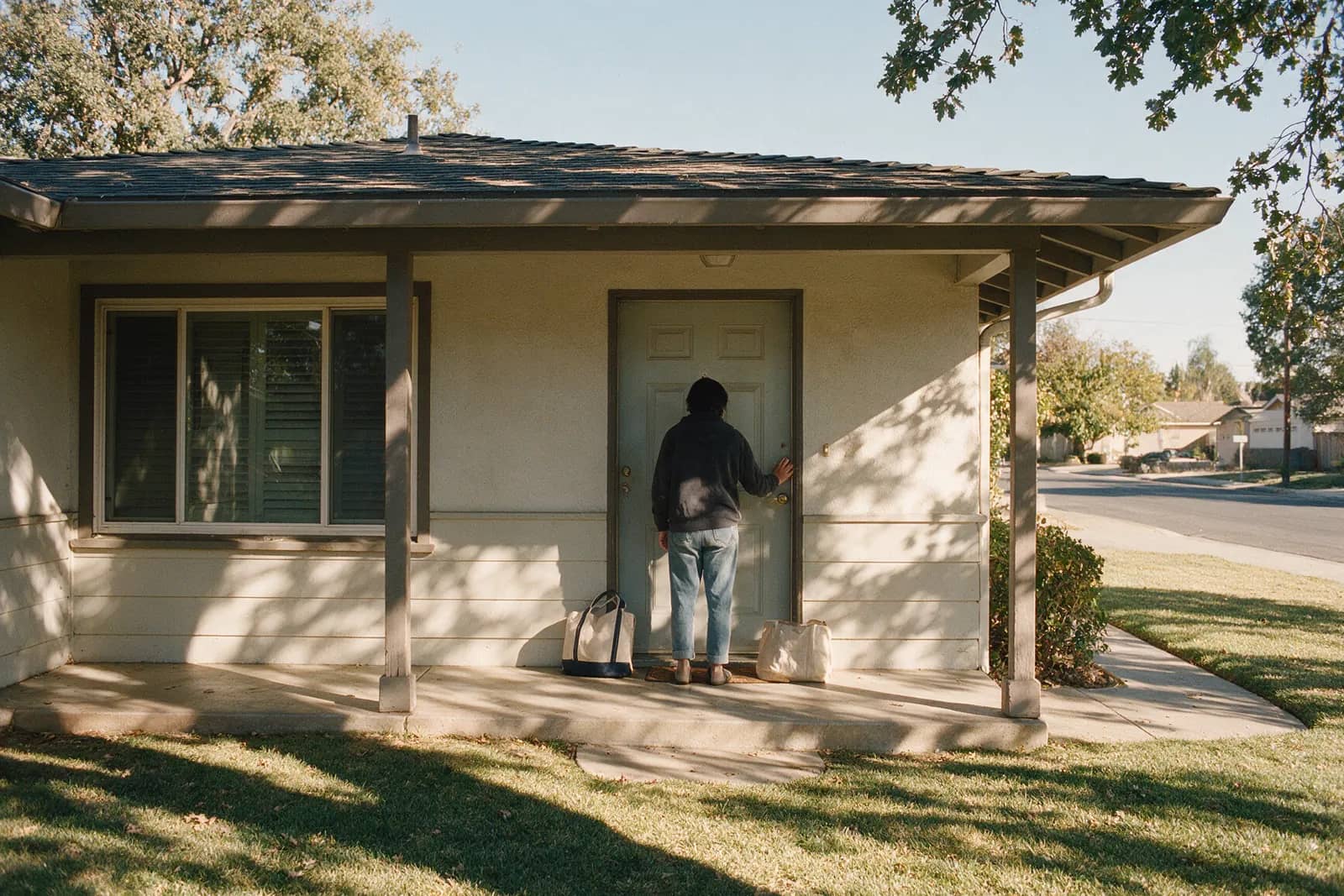
Why a round knob is the hardest thing on the door
A knob asks for three things at once: close the fingers around it, squeeze hard enough not to slip, and rotate the wrist. Arthritis, a healing fracture, neuropathy or simple loss of grip strength takes away any one of the three and the door stops working. People manage anyway. They wrap a towel around the knob for friction, they use both hands, they leave the door unlocked during the day because the deadbolt is the harder half. That last workaround is the one worth ending.
A lever asks for none of those things. It moves with a forearm, an elbow, a closed fist or a shopping bag hooked over it. It is the reason levers are standard on commercial doors and the reason so many Rossmoor manors and Walnut Heights ranch houses have quietly changed over. This is not a niche modification. It is the single cheapest change that keeps an older household using its own front door normally.
Which lever, and which direction it points
Two details separate a good lever from a frustrating one. First, the return: the end of the lever should curve back toward the door rather than stick straight out. A straight lever catches sleeves, purse straps and dog leashes, and on a narrow hallway it catches hips. A returned lever does not. Second, the handing: levers are usually reversible, and the technician sets the direction so the lever falls the natural way for the hand that uses it most.
The third thing is not the lever at all but the latch behind it. A worn latch needs the lever pushed hard and held to retract, which undoes the point of the change. When the whole lockset is replaced, that is solved in the same movement. Lock replacement and installation runs $109 to $295 per door, and interior doors are at the bottom of the range while an exterior entry set with a matching deadbolt sits nearer the top.
The inside of the deadbolt: the thumbturn nobody thinks about
A standard thumbturn is a thin blade about the width of a coin. Pinching it and twisting is exactly the motion a stiff thumb will not do, and it is the reason a deadbolt goes unused. The fix is a wide paddle-style turn, sometimes called an easy-turn, big enough to push with the side of a hand. Some deadbolts take a turn piece that swaps on its own; on others the whole interior half comes off and a new one goes on, which is still a short job.
Two other adjustments matter as much as the part. A bolt that binds because the door has dropped a fraction feels like a hardware problem but is a strike problem, and moving the strike plate a few millimeters restores a bolt that throws with a fingertip. And a door that has to be pulled toward you while turning the key is a door whose weatherstripping or hinge has moved. Neither of those needs new hardware, both are handled inside the visit, and both are worth naming on the call so the right parts ride along.
Keys, if a key is still part of the plan
A key can be made much easier without abandoning it. A large-bow key, or a plastic key turner clipped over the head, triples the leverage a hand has to work with. Every lock in the house on one key means one motion learned rather than four. Rekeying to a single key runs $23 to $39 per cylinder and is done in one visit, and the number of copies you end up carrying is decided before the work starts, not afterward.
The mailbox, the garage side door and the patio slider are the ones that get forgotten. A slider with a stiff foot bolt and a thin lift-lever is often harder than the front door and takes ten seconds of attention. Say on the call which doors are used daily and which are used twice a year, because the daily ones are where the money should go.
Where a keypad helps, and where it does not
A keypad removes the key entirely, which for some hands is the whole answer, and it lets a family member or a caregiver be given a code that can be taken back later without changing the lock. Smart lock installation is $169 to $430 including setup and a walk-through of how codes are added and removed. On a household where an adult child in Alamo or Concord needs to be able to get in, that is often the deciding feature rather than the technology itself.
It is not the answer everywhere. A keypad runs on batteries and those batteries eventually die, so a household that will not track a low-battery warning is better with a mechanical lever and an easy-turn. Anyone who finds a touchscreen hard to see in bright afternoon sun should try one before it goes on the door. And a keypad still needs a physical override key kept somewhere sensible, which means the key conversation does not disappear, it just moves.
What a whole-house changeover costs
A typical single-level house or manor: an entry lever set with a matching deadbolt and an easy-turn on the inside, a garage entry door, a patio door and two interior doors changed to levers. That is three exterior sets and two interior at $109 to $295 each, plus a rekey to one key at $23 to $39 per cylinder if any original cylinder is being kept. Most of that work is one visit of a few hours, and the service call of $89 is contained in the figure rather than charged on top.
The number is settled on the call from a description of the doors, and it covers the visit, the labor and the parts, so nothing is added later. The technician name and a thirty-minute arrival window arrive by text beforehand. Card or tap is taken at the door and an itemized receipt is emailed, which matters when the work is being reimbursed or shown to a family member who lives out of the area.
Quick answers
How much does it cost to change knobs to levers in a whole house?+
Each door runs $109 to $295 installed, with interior doors near the low end and exterior entry sets with matching deadbolts near the high end. A five-door house is usually one visit. The $89 service call is inside the total, not added afterward.
Can I keep my existing deadbolt and just make it easier to turn?+
Often, yes. Many deadbolts accept a wide easy-turn paddle on the inside, and on others the whole interior half is swapped. A bolt that binds usually needs the strike moved rather than a new lock, and that adjustment is done during the same visit.
Is a keypad a good idea for someone with limited hand strength?+
It removes the key and lets you give a caregiver a code you can revoke later, which is the main reason people choose one. It also runs on batteries and needs a low-battery warning to be noticed. If nobody will track that, a lever with an easy-turn thumbturn is the steadier choice.
Need it handled rather than read about?
(925) 940-8614