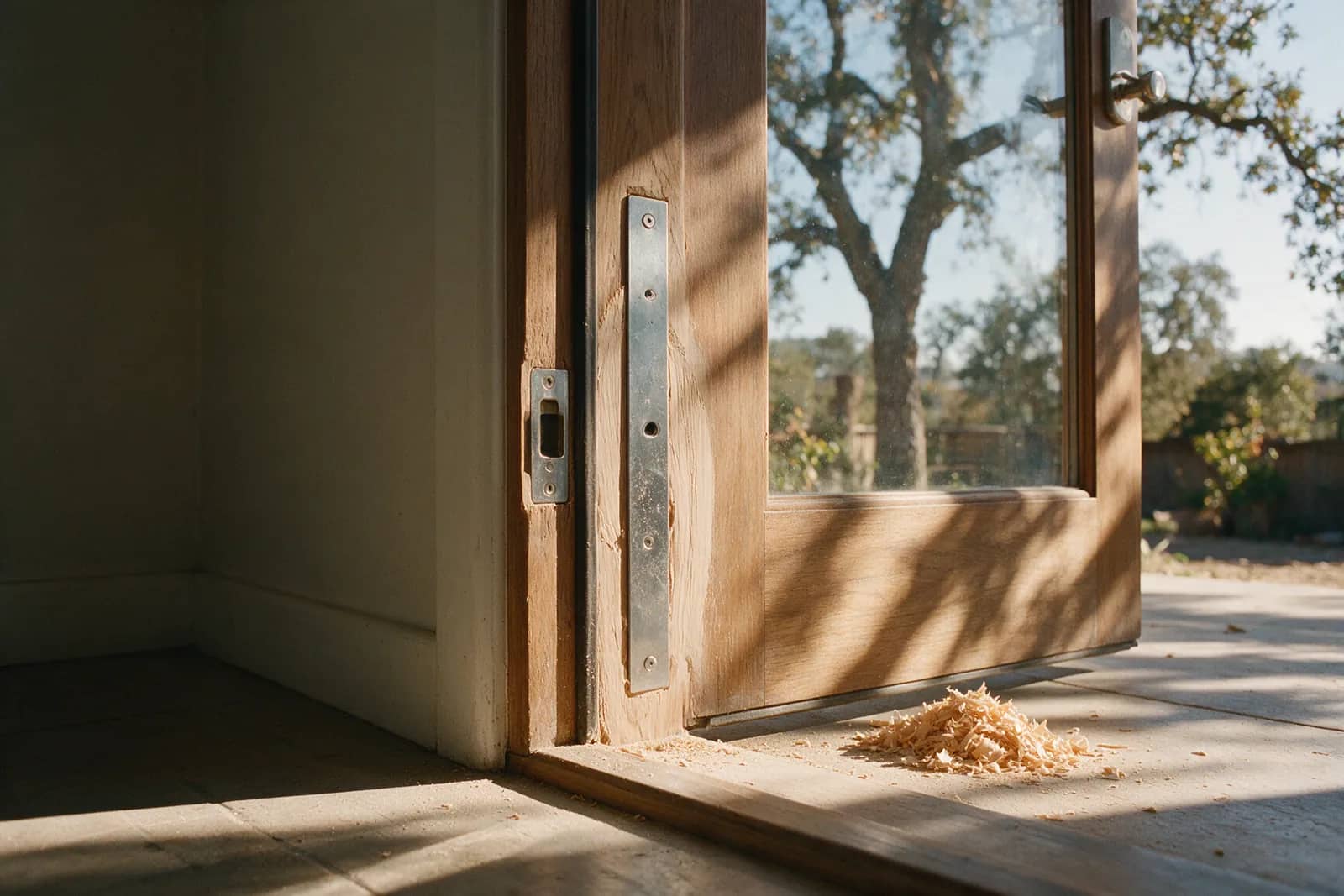
What is on the door of a 1955 ranch
Take the inside knob off a front door in Walnut Heights and the mid-century pattern appears. A cylindrical lockset dropped through a single round bore, a latch running to the edge, a separate deadbolt above it that was very likely added in the 1970s, and behind all of it solid fir or oak that no longer comes off a truck at that price. The knobs are usually cast brass or bronze with a small key, the roses are thin and flat, and the whole thing was built when hardware was expected to outlive the buyer.
The doors themselves are often better than anything sold today, which changes the question. This is not about whether old hardware is charming. It is about whether the lock on a door under sixty years of walnut and oak canopy still does the two jobs a lock has: keep the door shut in a way that resists a shoulder, and open smoothly for the person who lives there. Some of it does. Some of it stopped years ago and the household adapted without noticing.
The four ways it fails
First, the cylinder wears. Decades of a brass key in a brass plug rounds the pin chambers until the key needs a specific angle, and eventually until a similar key will turn it. That last stage is the one that matters, and it is invisible until somebody tests it. Second, the latch spring fatigues. The knob has to be turned further, then turned twice, then held while the door is pushed. Third, the door and the frame move with the seasons and the strike stops lining up, so the bolt binds or the latch meets the plate rather than the hole.
Fourth, and most common in this neighborhood, is grease. The lubricant packed into a lockset in 1955 has long since turned to varnish. On a cold February morning the bolt will not move at all, and by noon it works again, so nobody calls. That lock is not broken and it is not fine. It wants opening, cleaning and relubricating, which is a short job when it is a scheduled visit and an expensive one when it is a lockout at $115 to $195 on a January morning.
When keeping and servicing is the right answer
If the bore is intact, the case is sound, the knob is not loose on its spindle and the key still turns crisply, keep it. Servicing an original set costs less than replacing it and is priced in the $109 to $295 range, generally near the low end, because what is being paid for is time and small parts: a spring, a spindle, a set screw, clean grease and a strike moved a fraction. A door serviced this way behaves like new hardware and still looks like the house.
Rekeying old hardware is not a problem when the cylinder is a standard pin type, which most 1950s cylindrical sets are. It runs $23 to $39 per cylinder, same as anything modern, and putting the front, the kitchen door to the patio, the laundry room and the garage side door onto a single key is the request that comes up most often here. Households that have been in place since the 1970s frequently have four keys for a house that only ever needed one.
When replacement is honest
Replace when the cylinder is worn to the point that another key of the same family will turn it, when the case is cracked, when a knob wobbles because the spindle has rounded, or when the deadbolt has a bolt so short that it barely enters the frame. Some 1970s add-on deadbolts have a half-inch throw, which is decoration. A modern bolt with a full one-inch throw into a strike screwed to the framing is a genuinely different door. Lock replacement and installation runs $109 to $295 per door.
There is a middle path that suits these houses. Keep the original exterior knob for looks and let a new deadbolt do the security work above it, or move the original set to an interior door where it will be seen and admired and never asked to resist anything. Retrofit cylinders are also available for some old sets, so the outside of the door is unchanged while the inside is modern. Say on the call that the house is mid-century original, and the parts for all three options ride along on the first trip.
Adding a bolt to an old door without ruining it
Most Walnut Heights front doors have room for a second bolt, but the stile is what decides it. Measure the width of wood beside the glass or panel, check the backset of the existing bore, and place the new one so it does not break into the old pocket or run out the edge. A narrow-backset bolt exists for exactly this situation. Where the door is genuinely too thin, the right answer is to say so rather than drill and hope, and to put the effort into the frame instead.
The frame is where most of the gain is anyway. The strikes on these houses are held by three-quarter-inch screws into a jamb that was nailed to the framing seventy years ago. Replacing them with three-inch screws that reach the stud, on both the latch and the deadbolt strikes, costs almost nothing and changes how the door behaves under force more than any lock upgrade. If a door ever has been forced, post break-in lock repair runs $155 to $410 and includes that reinforcement as a matter of course.
Sliders, screen doors and the safe in the closet
Two other pieces of original hardware come up in every Walnut Heights visit. The aluminum patio slider, whose 1960s latch hooks a thin keeper and can often be lifted out of its track entirely, wants a new latch, anti-lift screws in the upper channel and a bar in the track. And the wooden screen door, which nobody thinks of as a lock at all, but which is what actually stands between an open house on a warm evening and the street.
The third is the safe. A surprising number of these houses have a small floor or closet safe installed by an owner who has since passed the house on, with a combination nobody wrote down. Safe opening runs $175 to $495 and is a daylight appointment, not an emergency. It is opened without damage where the mechanism allows, and the alternatives are explained with the figures attached before anything else is decided. Arrival to Walnut Heights is about fourteen minutes, and nearly all of this work is booked rather than urgent.
Quick answers
Can 1950s knobs and deadbolts be rekeyed to one key?+
Usually yes. Most mid-century cylindrical sets use a standard pin cylinder that rekeys at $23 to $39 per cylinder, and where keyways match, the front, back, garage and laundry doors go onto one key at no extra charge for the matching.
Is my original hardware secure enough to keep?+
It depends on wear rather than age. If the key turns crisply, the case is sound and the deadbolt throws a full inch into a strike anchored to the framing, keeping it is reasonable. A worn cylinder that a similar key will turn, or a half-inch bolt, should be replaced.
Will adding a second deadbolt damage an old ranch door?+
Not when the stile is measured first and the new bore is placed clear of the existing pocket. Narrow-backset bolts exist for thin stiles. If a particular door has too little wood, that is said plainly and the money goes into long screws and reinforced strikes instead.
Need it handled rather than read about?
(925) 940-8614